Six products. One record.
Run the operation and command the collection on one connected platform — the market side of the trade and the operational side under it, finally joined. Every product below reads and writes the same four things: Party, Object, Condition, Document.
One connected suite, not another silo.
The trade's software is fragmented — one tool to sell, another to ship, another to store, none of them connected. Verso brings them together: one platform for the market and the operation, on a single record. A decision on one side becomes action on the other, by permission.
Logistics ERP
Quotations grouped by customs regime, the dispatch desk, the atelier bench, freight on a real map, condition, documents and finance — the whole operation on one job record.
EnterCollection & marketEcosystem
Works, editions and consignments on one register; the pipeline from enquiry to settlement; the client book, viewing rooms and the storefront.
EnterNetworkProjects
Fairs, hubs and registries run as one project — participants, quotes, operations and invoices for forty galleries at once.
EnterClient areaConnect
The client's own door: shipments, quotations, paperwork, objects and outcomes — one place, by relation, nothing re-keyed.
EnterIn the pocketMobile
Operator for the desk on the move; Collection for the owner. The same record, seen by permission.
EnterAcross all✦Verso AI
Drafts on the record you are looking at. A person signs everything — nothing commits itself.
EnterSix systems that each hold a piece of the same object.
Nobody in this trade set out to run a disconnected operation. It happened one sensible purchase at a time, and the cost only shows up at the seams — which is where the object actually is.
| On separate systems | On one record | |
|---|---|---|
| The object | Entered in the CRM, re-entered in the shipping system, re-entered on the condition form, re-entered on the invoice. Four versions, four people, one work. | Entered once. Every product reads the same object, and a change to it is a change everywhere at once. |
| A sale that needs shipping | An e-mail with dimensions pasted into it, and a shipper who re-types them at midnight. | A door. The operator sees the object’s facts — never your prices, your collectors or your provenance. |
| Condition | A PDF in a folder on somebody’s drive, named after the date it was written. | A versioned state on the object itself. Append-only, positioned, signed — and the same history the owner and the crew read. |
| The paperwork | Drafted from a previous job’s paperwork, because that is faster than looking it up. | Drafted from the record’s own parties, objects and values, reviewed and signed by a person, filed to the object. |
| Who knows what | Each party knows their slice and assumes about the rest. The gaps are found when something is already late. | Each party sees their own scope of one record, by relation. Nobody assumes, because nobody has to. |
What each one is actually for.
Six products, switched in place rather than six pages you have to hold in your head at once.
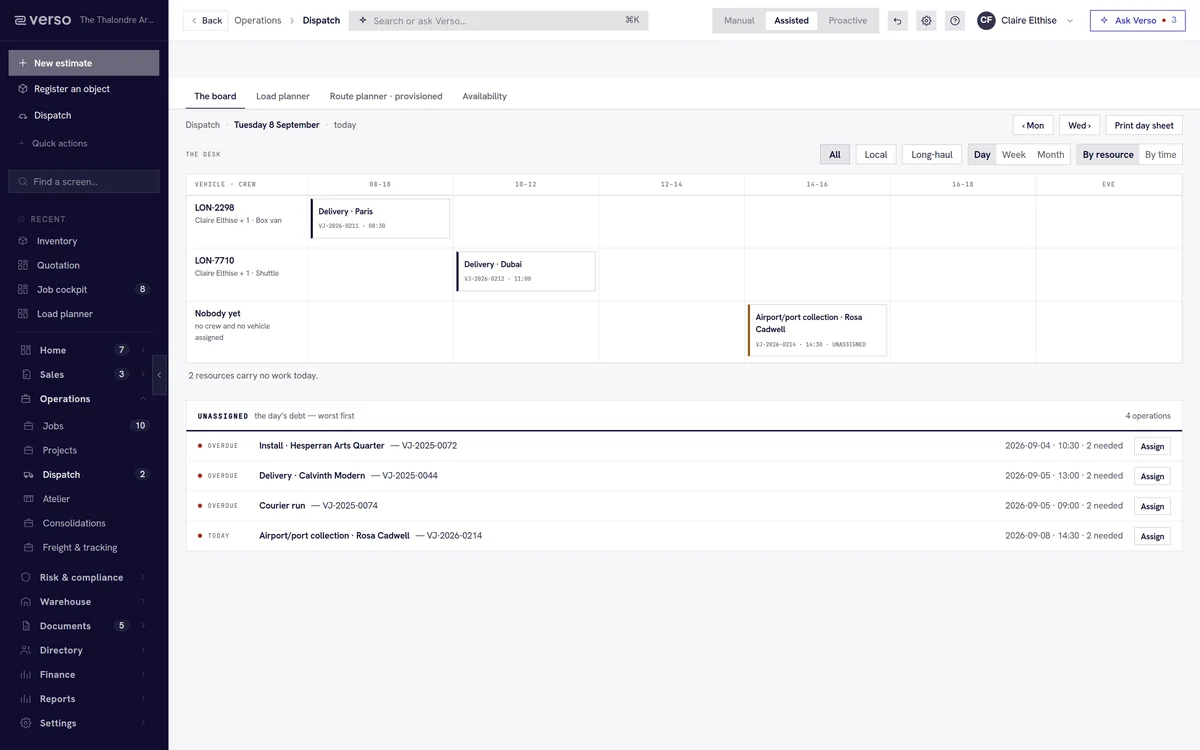
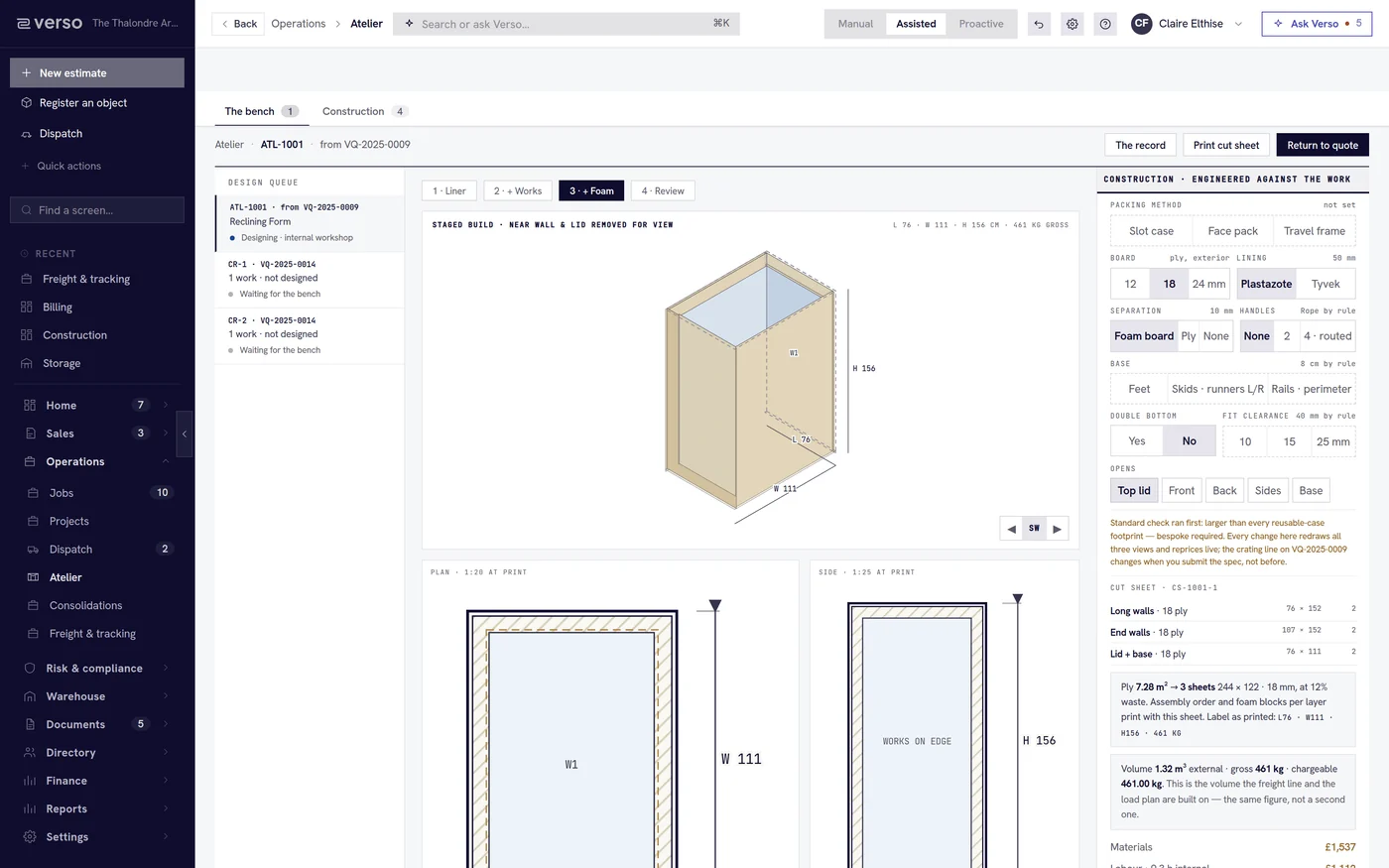
The operations command centre
Every desk of a specialist art logistics operation — sales, quotations, dispatch, atelier, freight, warehouse, documents and finance — as one system on one job record.
- Quotations grouped by customs regime, priced against your own rate book.
- The dispatch desk the day actually runs on, with the field answered where the day is planned.
- An atelier that outputs the cut sheet the carpenter cuts, with volumetrics flowing live to the freight line.
- Freight on real geography, driving the job rather than being reported into it.
The collection & market command centre
The gallery, the dealer desk and the collection as one working system — works, editions and consignments; the pipeline from enquiry to settlement; the client book, viewing rooms and the storefront.
- Every work’s whole life as dated entries with a person and an undo, not a status somebody overwrote.
- A pipeline where you do the act and the stage follows — sold means the money came.
- Viewing rooms and a storefront you switch on per work.
- And when a sale needs a crate and a flight, logistics is a door rather than an e-mail chain.
The demo register behind this screen is being re-shot on a cleared tenant. The capture returns with that build.
EcosystemMany parties, many objects, one workspace
A fair, a hub, a registry: many parties acting on many objects at once, in one shared workspace instead of six inboxes. This is the part no ERP has.
- The organiser sets the dates, the venue, the tariff and the deadlines, and invites the parties in.
- Each participant sees their own scope on the same objects — and nothing of anyone else’s.
- Quotations come from the organiser’s tariff, with the regime derived from the entry.
- Every act lands on the object once, seen by whoever is permitted, re-keyed by no one.
The demo register behind this screen is being re-shot on a cleared tenant. The capture returns with that build.
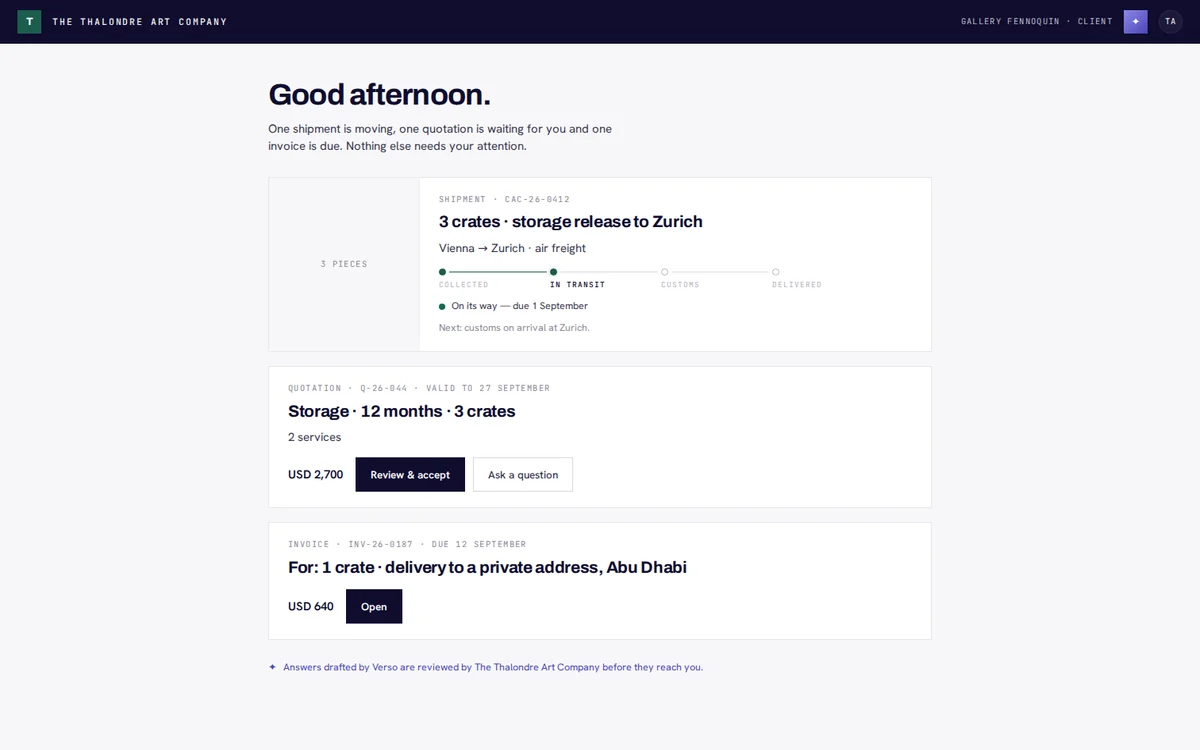
ProjectsYour clients’ door, in your brand
A firm’s own front door onto the record, in the firm’s colours. Access is granted by relation, not by login: a client sees what they are contracted for, a participant what they are part of.
- Sign-in comes from the tenant’s own identity provider, not from us.
- One shipment moving, one quotation waiting, one invoice due — and it says when nothing else needs you.
- Accepting a quotation needs a typed signature. Nothing commits itself.
- Answers drafted by Verso are reviewed by the tenant before the client reads them.
The record, in the field
Two phones on the same record. Field, for the crew: the day’s run, the crate, the condition check at the door. Collection, for the owner: their works, wherever they are.
- The crew writes to the object as it happens, not typed up that evening.
- A survey appends; it never overwrites.
- The owner reads the same condition history the desk and the crew wrote.
- A request from an owner lands in a real operator’s inbox as work.
It drafts. You sign. Nothing commits itself
One assistant across the whole platform, always reading the live record in front of you and never anything else.
- Drafts quote lines with the reason they are there, priced from your rate book.
- Ranks what needs you first thing, and says why it ranked.
- Writes the condition summary from the checks already on the object.
- Signs nothing. The signature is the moment of record, and it is always human.
Four things, one truth.
Every product reads and writes the same four entities — so nothing is ever a second copy, and nothing is re-typed between a sale and a crate.
Everyone in the trade
Collectors, galleries, packers, insurers — one identity across the system, with the basis you hold each contact on.
The thing itself
Identity, value, location and history, captured once. Custody is a state, not membership.
A versioned state
Held on the object, not in a folder. Append-only: every check kept, every report signed.
Drafted, signed, filed
Quotations, invoices, carnets, condition notes — drafted from the record, signed by a person, filed to the object.
It drafts. You sign.
Verso AI works inside every product on the platform — reading the record in front of you, drafting the work, waiting for a person. The dial is yours: Manual, Assisted, Proactive.