Every move, priced, planned and proven.
Built for specialist art logistics — the quotation that knows customs regimes, the dispatch desk the day actually runs on, the atelier that outputs a carpenter’s cut sheet, and freight tracked on a real map. All of it on the shared record your clients see.
Eight screens, in the order the day runs.
Every one is a real capture of the current build on the demo tenant. Click a screen, arrow through them, or let it run.
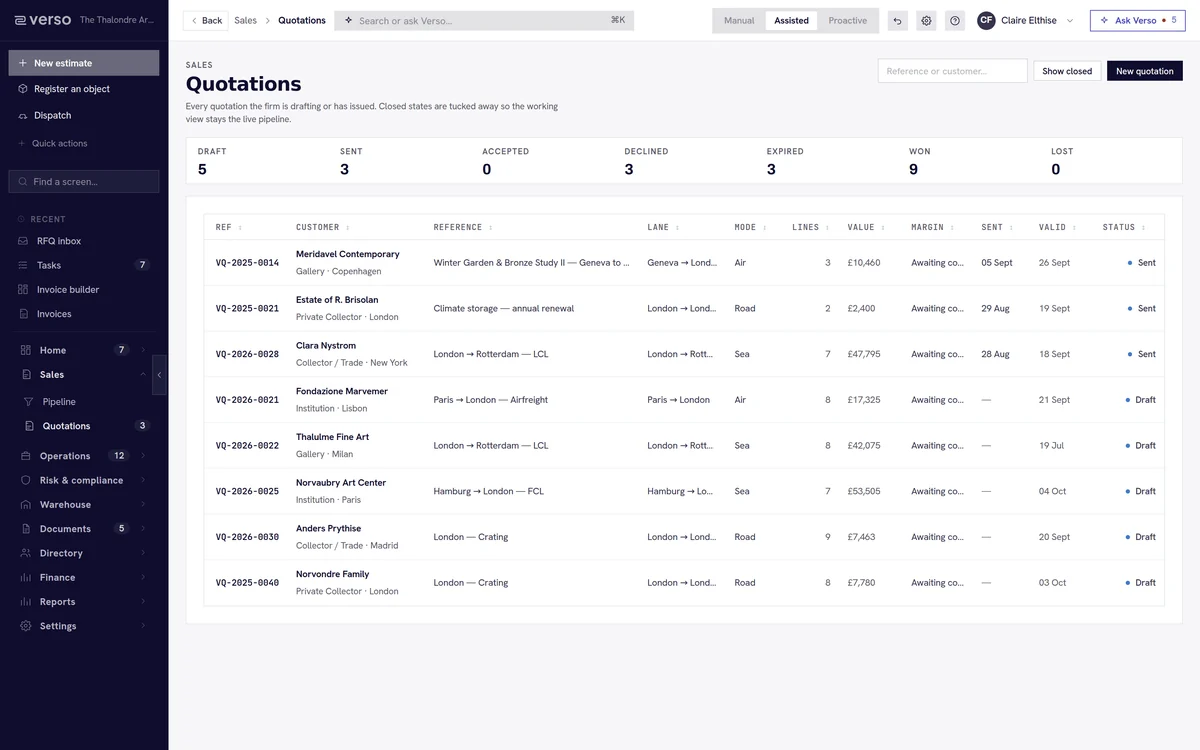
Every quotation the firm is drafting or has issued, with the live state of each across the top — draft, sent, accepted, declined, expired, won, lost. Lines price against your own rate book, and margin resolves only for the people entitled to see it.
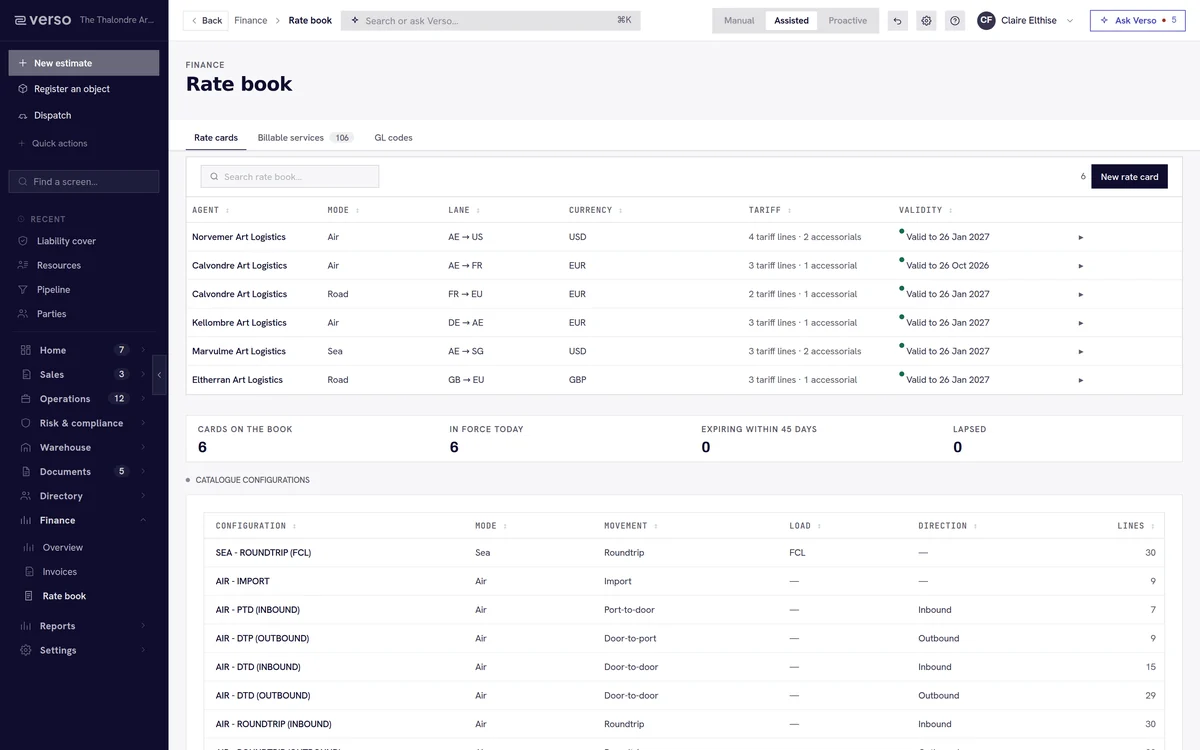
The services the firm sells with their rates and rules. The quotation reads from it, so a price is never typed twice and never invented at the desk.
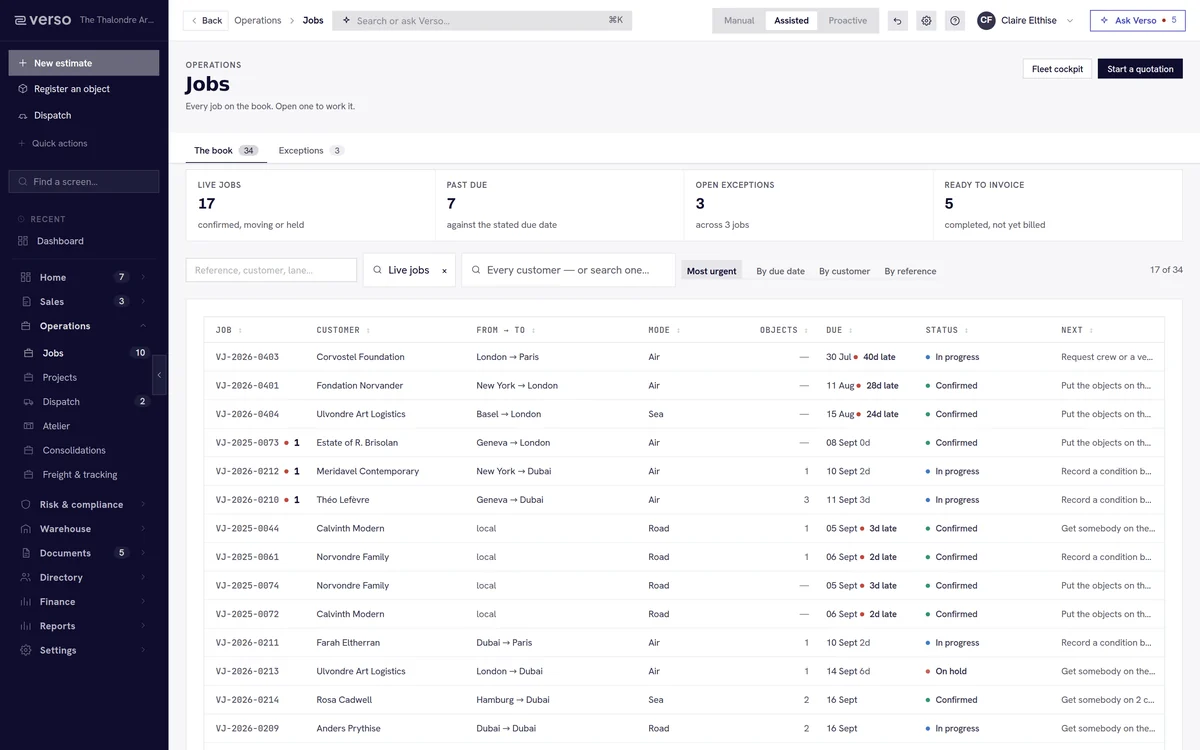
Accept a quote and the job exists — same parties, same objects, same values, nothing re-typed. Filter by lane, read status as a dot and a word, and open any job onto the record the market side already holds.
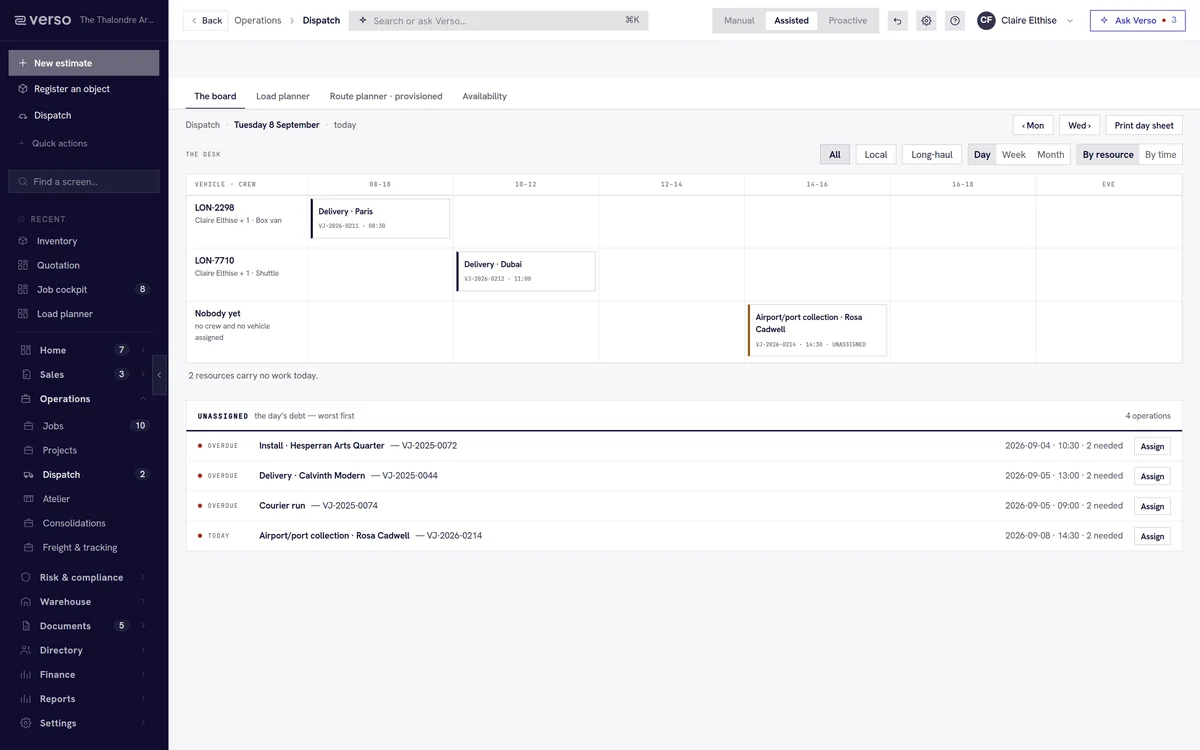
Vehicles and crew across the day, with requests from the field answered where the day is planned. Clashes surface before the crew leaves rather than at the door.
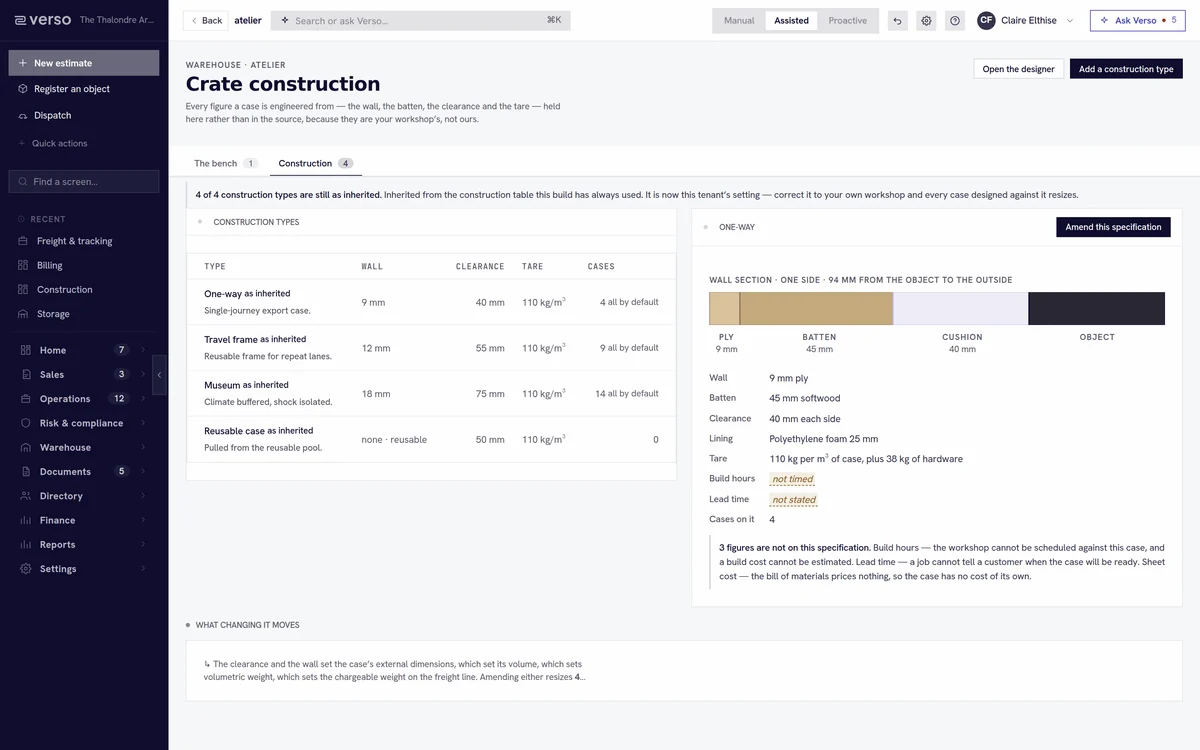
Staged build — liner, works, foam, review — engineered against the work. The carpenter prints the cut sheet, and the volumetrics flow to the freight line as the case is drawn.
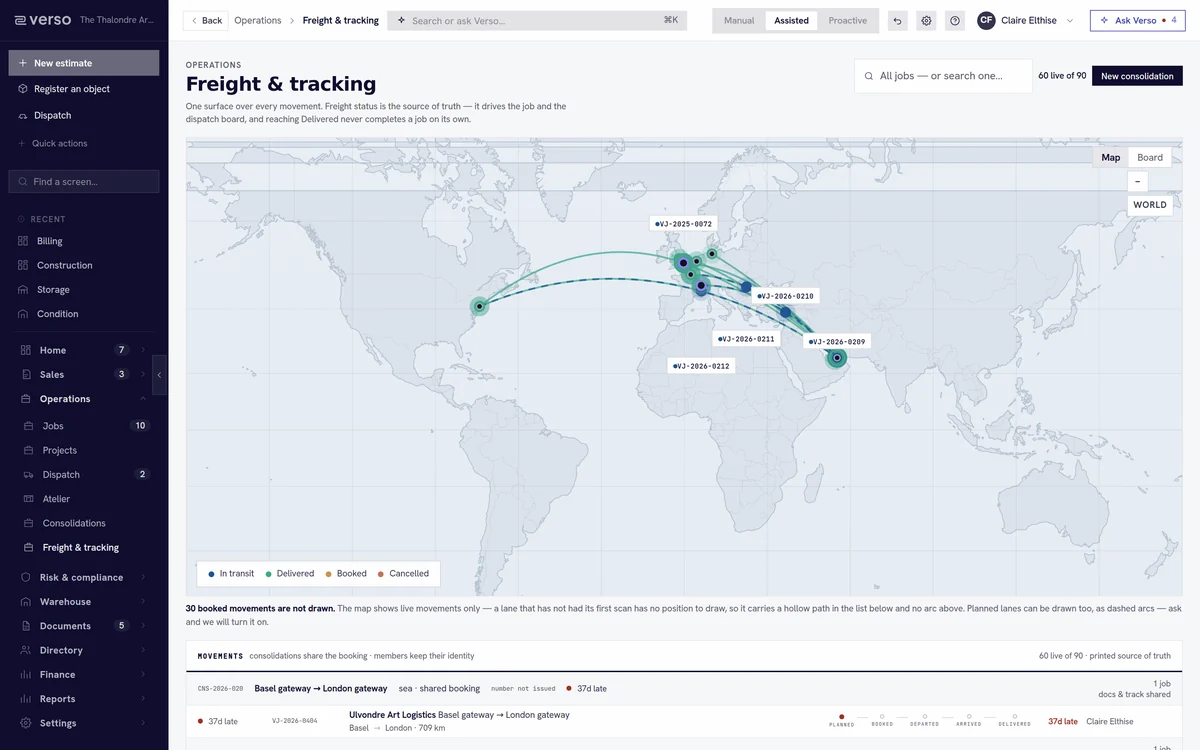
Live movements on real geography. Freight status is the source of truth — it drives the job and the dispatch board, and reaching Delivered never completes a job on its own.
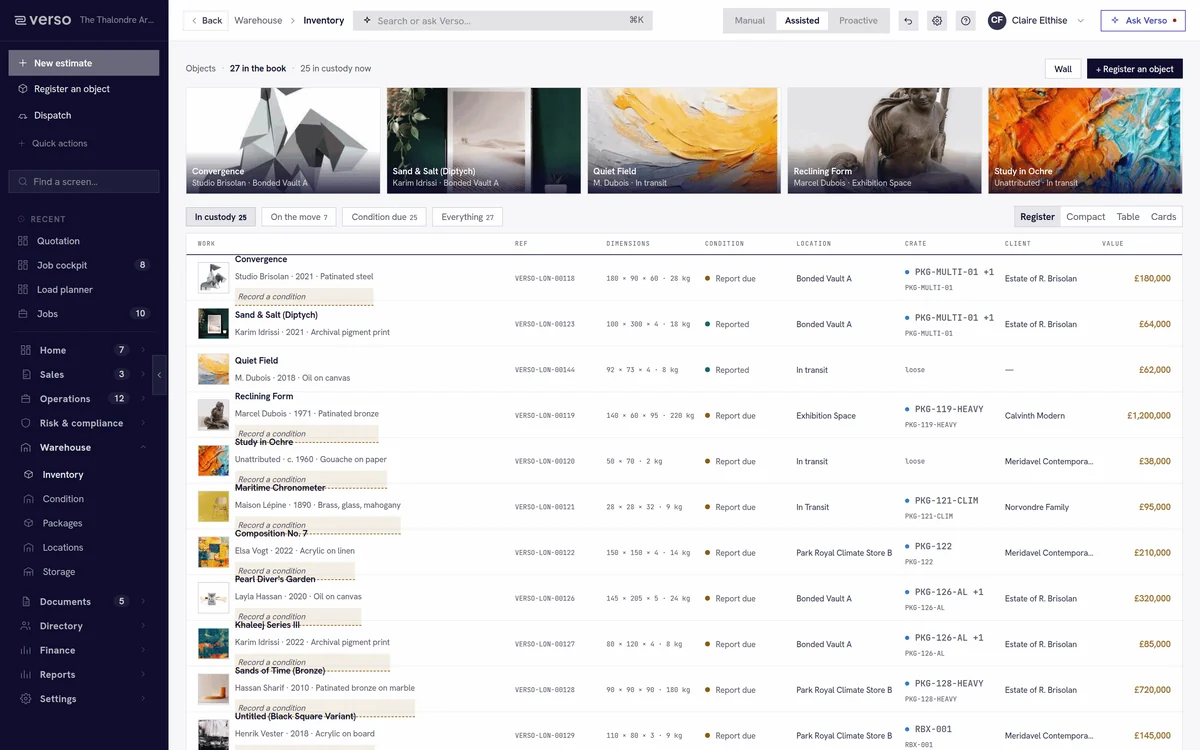
What is in store, whose it is, and where — to site, zone and rack. Location is held on the object itself, and the register is append-only: each move is a new line, never an overwrite.
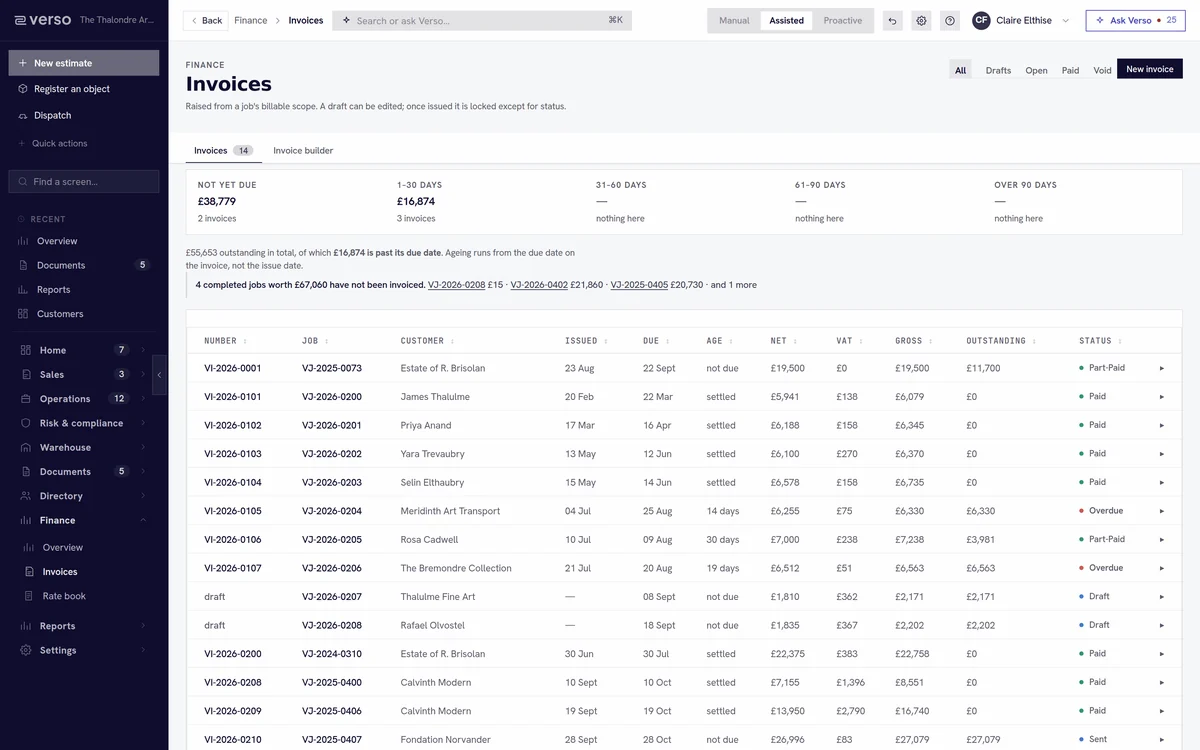
What is invoiced, what is owed and what has arrived — the desk’s own view of the money, with value spoken in brass.
From a client’s e-mail to a priced quotation, without re-typing a line.
Most of the work in quoting is not pricing. It is reading what the client sent, working out what the objects actually are, and turning that into volumes and services. Verso does that part, and hands you a draft. Click through the stages.
Whatever the client actually sent
A list pasted into an e-mail, a packing list, a spreadsheet of works, an insurance schedule, or a PDF from the gallery. Rarely a form, and never the form you asked for.
Reads the document and lifts the objects out of it — titles, artists, dimensions, media, values, dates — into a table you can correct before anything is priced.
A list of objects on the record, each one editable, with the source document attached to it so anyone can check the reading against the original.
The works, as objects rather than rows
The extracted list, plus whatever you already hold on those works from previous jobs.
Matches against objects already on the record so a work you have moved before is recognised rather than duplicated. Unmatched works become new objects.
Objects with identity, dimensions and value — not a spreadsheet row that dies with this quotation.
Dimensions become crates, and crates become chargeable weight
Each object’s dimensions, fragility and orientation, and the construction types your workshop actually builds.
Engineers the case against the work — wall, batten, clearance, cushion — and computes external dimensions, volume, tare and volumetric weight from it. Consolidation is worked out across the whole list, not per line.
A crate specification per object or group, with the volumetric and actual weights the freight line will be priced on.
What customs believes is happening
The origin, the destination, the purpose of the movement and whether the object is expected back.
Derives the customs regime from the movement rather than letting anyone type it on a line, and splits the quotation accordingly — export, import, re-export, re-import.
A quotation grouped by regime, with the paperwork each one implies attached to it.
Against your book, and your agents’ books
The services the job implies, your own rate book, and the rates your agents and carriers have given you for these lanes.
Prices every line from the rate book rather than from memory, applies your raises and margins, and resolves agent costs on the legs they cover. Margin is computed on the record and shown only to the people entitled to see it.
A priced quotation, per regime and per leg, that can be checked line by line against the book it came from.
A person decides
The draft quotation, whole, with every figure traceable to where it came from.
Presents it for review. Verso does not send, does not commit, and does not price anything you have not seen.
A quotation issued by a named person, on the record, with the client’s door showing exactly what was sent.
The quote is the easy part. Reading what the client sent, and turning it into objects, crates and weights — that is the day.
A quote becomes a job, a crate, a flight, an invoice.
Five moves, and nothing re-entered between any two of them.
- 01Quotation
Priced by regime and by leg
Grouped as customs thinks — export, import, re-export, re-import — with every line priced against your own rate book and margins visible only to the owner.
- 02Job
The accepted quote, carried
Accept, and the job exists: the same parties, the same objects, the same values. Nothing is typed twice, so nothing can disagree.
- 03Crate
Engineered at the bench
The atelier designs against the work and prints the carpenter’s cut sheet. Volumetrics flow to the freight line as the case is drawn, not after it is built.
- 04Movement
Tracked on real geography
Freight status is the source of truth — it drives the job and the dispatch board. Reaching Delivered never completes a job on its own.
- 05Invoice
Drafted from the record
Documents and invoices are drafted from the job’s actual parties, objects and values, reviewed by a person, and filed to the object.
- Drafts a quotation from an enquiry, priced against your rate book.
- Reads an incoming document and proposes the lines it implies.
- Ranks what needs you first thing, and says why.
- Answers a question about this job on the screen you are already on.
Every one of these drafts. None of them commits. You sign, and the record shows who signed.
Four regimes, four different jobs.
Every operator knows this; almost no software encodes it. The regime is derived from what the movement actually is, and it changes the paperwork, the guarantee and the way the line is priced.
| Regime | What the movement is | What changes on the job |
|---|---|---|
| Export | The object leaves and is not expected back. | Export declaration; no import duty on your side. The destination’s charges are the consignee’s, and the quotation should say so rather than silently absorbing them. |
| Import | The object enters and stays. | Import entry, duty and import VAT at the destination’s rate for the category. Deferment or a guarantee may be needed before the goods will release. |
| Re-export | It entered temporarily and is now leaving. | The temporary entry has to be discharged by proving departure. An undischarged entry becomes a debt against whoever guaranteed it. |
| Re-import | It went out temporarily and is coming home. | Relief depends on proving it is the same object that left — which is an evidence problem, and why the outbound condition record matters at the inbound border. |
Verso groups a quotation by regime for exactly this reason, and derives the regime from the entry rather than letting anyone type it on a line. The longer version is on the Knowledge desk.
Directory, risk and the day’s brief.
Every party, one identity
Clients, vendors, agents and carriers — the people and firms the operation works with, on the same record the market side holds.
EnterRisk & complianceHeld where the work is
The checks the job has to pass — kept on the job, not in a spreadsheet beside it.
EnterDashboardThe day, as it opens
Open quotations, quoted value, live jobs, in transit, collected — and what needs you, ranked.
Enter